
Healthy soil is the foundation of a thriving garden, lawn, or farm. Understanding its composition is key to optimizing plant growth and ensuring long-term sustainability. Soil testing provides valuable insights into nutrient levels, pH balance, and soil structure, allowing you to make informed decisions about fertilization, amendments, and planting strategies.
Recently, I decided to have my soil tested at the University of Georgia’s Soil, Plant, and Water Laboratory to better understand the condition of my heavy clay soil and determine the best course of action to improve it.
Getting my soil tested at the University of Georgia was an incredibly valuable experience. The process was easy, and I gained quite a bit of insight into my garden soil. By analyzing my soil’s characteristics, I was able to create a tailored approach to improving its fertility and structure, ensuring better plant growth in the seasons to come.
The detailed report provided actionable steps to improve my soil, and I now feel confident in making informed decisions for my garden and lawn.
The Soil Testing Process
Submitting my soil sample was simple. I followed the recommended steps:
- Collecting the Sample: I took multiple samples from different spots in my yard, digging down about 6 inches to get a representative mix.
- Preparing the Sample: You will need approximately 1 cup of soil per sample. Soil can be put into any container or bag, and the lab will transfer it to soil bags at the time of submission. Samples should be air-dried overnight by spreading them on a flat surface lined with clean white paper. Take care to avoid contamination.
- Submitting the Sample: After drying, transfer the sample to a soil sample bag and bring it to your local Extension office to fill out submission forms and specify which recommendations and information you need.
- Sending It In: I labeled my sample with my name and location and sent it to the University of Georgia’s Soil, Plant, and Water Laboratory.
You can also follow our guide on How to Test Your Garden Soil for a more detailed approach.
Different Levels of Soil Testing
Depending on what you are looking for, there are different levels of soil testing available. The cost varies based on the comprehensiveness of the test:
Diagnostic Tests and Pricing
| Routine Soil Test (S1) – $10 | Routine Plus Soil Test (S2) – $16 | Priority Pollutants (S41) – $154 | Single Metal/Non-Metal (S42) – $54 |
| pH Lime requirement Phosphorus (P) Potassium (K) Calcium (Ca) Magnesium (Mg) Zinc (Zn) Manganese (Mn) | Includes S1 elements Sodium (Na) Iron (Fe) Copper (Cu) Molybdenum (Mo) Nickel (Ni) Lead (Pb) Chromium (Cr) Cadmium (Cd) Cation Exchange Capacity | Includes multiple toxic element screenings Add any additional element from S42 for $10 Antimony (Sb) Arsenic (As) Beryllium (Be) Cadmium (Cd) Chromium (Cr) Copper (Cu) Lead (Pb) Nickel (Ni) Selenium (Se) Silver (Ag) Thallium (Tl) Zinc (Zn) | Add any additional element for $10 Includes options such as Aluminum (Al), Antimony (Sb), Arsenic (As), Barium (Ba), Beryllium (Be), Cobalt (Co), Gold (Au), Phosphorus (P), Potassium (K), Sodium (Na), Sulfur (S), and many more. |
What I Learned from My Soil Test Results
Within about ten business days, I received my results via email. The report was detailed, providing valuable data on my soil’s pH, nutrient levels, and recommendations for improvement.
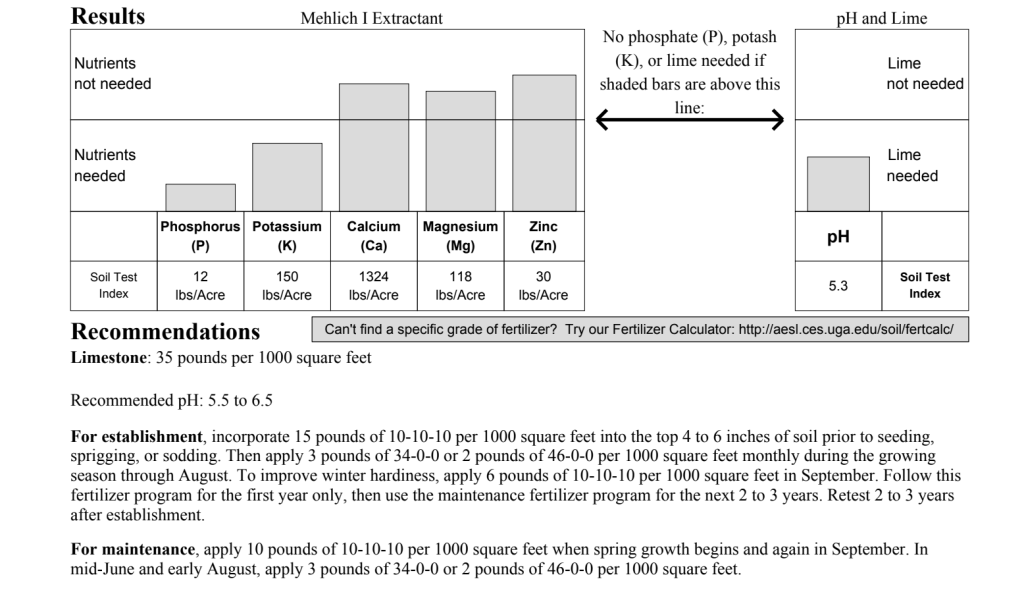
My soil test revealed several key insights:
The soil pH is 5.3, which is acidic. The recommended pH range is between 5.5 and 6.5. Because your pH is below the ideal range, applying lime is necessary to help neutralize the acidity. The recommendation is to apply 35 pounds of limestone per 1,000 square feet.
The test results indicate which nutrients are in sufficient supply and which need to be added.
- Phosphorus (P) is at 12 lbs/acre, which is low and needs to be supplemented.
- Potassium (K) is at 150 lbs/acre, which is also low and requires supplementation.
- Calcium (Ca) is at 1324 lbs/acre, which is sufficient, so no additional calcium is needed.
- Magnesium (Mg) is at 118 lbs/acre, which is adequate.
- Zinc (Zn) is at 30 lbs/acre, which is also sufficient.
This means you need to add phosphorus and potassium but do not need to supplement calcium, magnesium, or zinc.
Recommendations and Next Steps
Lime Application
To raise the soil pH closer to the ideal range, apply 35 pounds of limestone per 1,000 square feet. Lime should be incorporated into the soil before planting for best results.
Fertilization Plan
If you are establishing a new lawn or planting a new crop:
- Incorporate 15 pounds of 10-10-10 fertilizer per 1,000 square feet into the top 4 to 6 inches before planting.
- Apply nitrogen fertilizer monthly during the growing season through August. This means applying 3 pounds of 34-0-0 or 2 pounds of 46-0-0 per 1,000 square feet.
- In September, apply 6 pounds of 10-10-10 per 1,000 square feet to improve winter hardiness.
- This fertilization schedule should be followed for the first year only. After that, switch to a maintenance program.
For maintenance:
- Apply 10 pounds of 10-10-10 per 1,000 square feet when spring growth begins and again in September.
- In mid-June and early August, apply 3 pounds of 34-0-0 or 2 pounds of 46-0-0 per 1,000 square feet.
Additional Considerations
Water thoroughly after applying fertilizer to prevent burning and ensure nutrient absorption. Avoid fertilizing when grass or plants are wet. Grass clippings do not contribute to thatch if managed properly, so they need not be removed. However, if clippings are removed, the fertilizer application rate should be increased by 30 percent to compensate for the lost nutrients.
The test recommended that we Retest the soil in two to three years to monitor nutrient levels and pH adjustments.
Where to Get Your Soil Tested
If you’re interested in getting your soil tested, there are many reputable labs across the country. Here are some options by state:
- University of Georgia Soil, Plant, and Water Laboratory (GA) – Website
- Auburn University Soil Testing Laboratory (AL) – Website
- University of Florida IFAS Extension Soil Testing (FL) – Website
- Texas A&M AgriLife Extension Soil, Water, and Forage Testing Laboratory (TX) – Website
- University of California Agricultural and Natural Resources Lab (CA) – Website
- University of Minnesota Soil Testing Laboratory (MN) – Website
- Penn State Agricultural Analytical Services Laboratory (PA) – Website
- University of Illinois Extension Soil Testing (IL) – Website
- Cornell University Soil Health Laboratory (NY) – Website
- North Carolina Department of Agriculture Soil Testing Lab (NC) – Website
- University of Kentucky Soil Testing Laboratory (KY) – Website
- University of Tennessee Soil, Plant, and Pest Center (TN) – Website
- Ohio State University Soil Testing Laboratory (OH) – Website
- Michigan State University Soil and Plant Nutrient Laboratory (MI) – Website
If you’re considering testing your soil, I highly recommend utilizing a professional service like the University of Georgia’s Soil, Plant, and Water Laboratory. The process was easy, the results were clear, and the insights were well worth the effort.
Regular soil testing every few years will help ensure that I continue to provide the best possible growing conditions for my plants.