
Seeing a red bird makes you stop and take a closer look. Whether it’s perched on a snowy branch, hopping around beneath a bird feeder, or resting in a leafy tree, that splash of color is hard to miss.
Many red birds are males showing off their breeding plumage, while females tend to have brown, olive, or muted yellow feathers that help them blend into their surroundings. Their colors can vary with age, season, and diet, so you might be surprised by how different males and females of the same species look.
From familiar backyard cardinals to bright red birds found in the desert and mountains, these 15 species are worth watching for the next time you step outside.
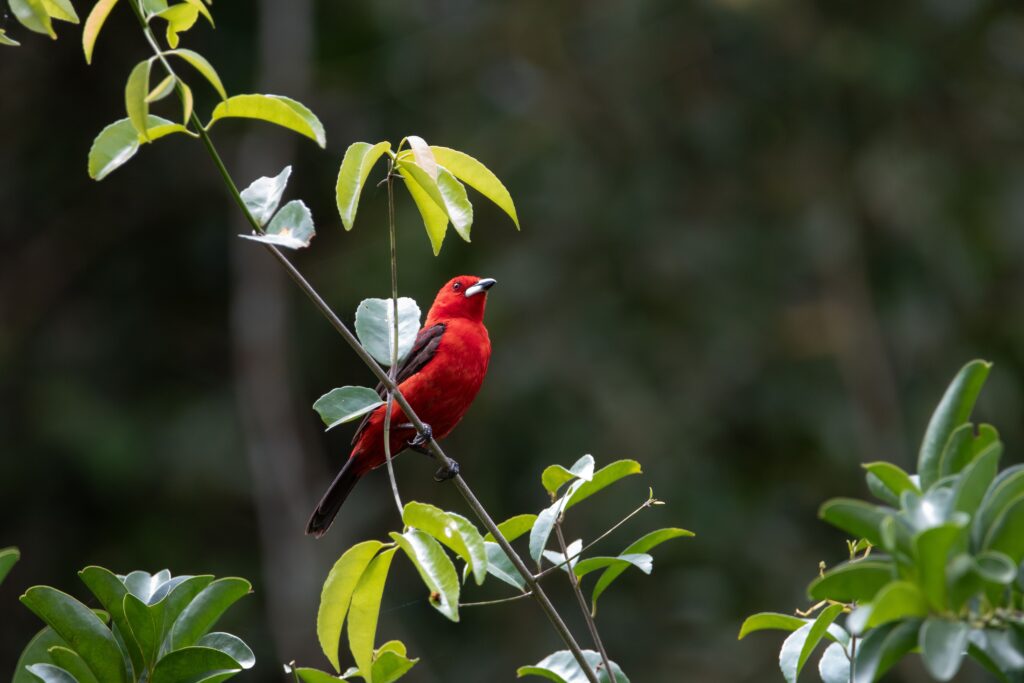
1. Northern Cardinal (Cardinalis cardinalis)
The Northern Cardinal is one of the easiest red birds to recognize, thanks to the male’s brilliant red feathers, pointed crest, and black mask around the face. Females have warm brown plumage with reddish highlights on their wings, tails, and crests, and both sexes have thick bills suited to cracking seeds.
Cardinals spend much of the year in the eastern and central United States, so they regularly visit backyard feeders. They favor black oil sunflower seeds, and dense shrubs provide good places to shelter and nest.
Related: Birds Are Avoiding Your Yard — Here’s Why
2. Scarlet Tanager (Piranga olivacea)
A male Scarlet Tanager in breeding plumage is hard to mistake, with a bright scarlet body and solid black wings and tail. Females and nonbreeding males are more subdued, with yellow-green or olive coloring that blends into the forest canopy.
These birds spend the breeding season in deciduous forests across eastern North America before migrating to South America for winter. Look for them high in mature trees, especially if your property borders woodland or you’re walking through a forest during spring or summer.
Related: 10 Bird Feeder Mistakes That Could Put Wild Birds at Risk
3. Summer Tanager (Piranga rubra)
The male Summer Tanager has an almost entirely red body, giving it a smooth, even appearance without the black wings seen on a Scarlet Tanager. Females are usually yellowish or greenish-yellow, while younger males may take time to develop their full red plumage.
Summer Tanagers breed across parts of the southern and eastern United States and favor open woodlands, particularly areas with oak trees. They mainly eat insects, including bees and wasps, and may be easier to spot when they perch in the open or visit fruit-bearing trees.
Related: 12 Simple Ways to Keep Birds From Nesting on Your Porch
4. House Finch (Haemorhous mexicanus)
House Finches are common in neighborhoods, parks, and suburban gardens, where they often gather in small flocks around feeders. Males have reddish heads, chests, and rumps, while females are brown with streaked underparts.
The shade of red varies from one male to another because pigments come from their diet. Offer sunflower seeds and clean water, and you may see House Finches return year-round.
5. Pine Grosbeak (Pinicola enucleator)
The male Pine Grosbeak has soft rosy-red or pinkish-red feathers across much of its head and body, with gray wings and a stout, dark bill. Females are usually grayish with yellow or orange tones, giving them a gentler look.
These large finches live mainly in northern forests and mountainous regions, where they feed on seeds, buds, and berries. In some winters, they move farther south for food, so crabapple trees and other fruit-bearing plants can offer a chance to spot one.
Related: 11 Beautiful Birds to keep an eye out for this winter
6. Red-breasted Nuthatch (Sitta canadensis)
The Red-breasted Nuthatch has a rusty-orange chest and belly, a blue-gray back, a white face, and a dark stripe running through the eye. It’s a small, energetic bird with an unusual habit of climbing headfirst down tree trunks while searching for insects and seeds.
These nuthatches live in coniferous forests and sometimes visit backyard feeders, particularly during colder months or when food is scarce. Sunflower seeds, peanuts, and suet may attract them, while mature trees offer places to forage and nest.
7. Cassin’s Finch (Haemorhous cassinii)
Male Cassin’s Finches have rosy-red coloring on the crown, face, and chest, with brownish streaks across the belly. Females are heavily streaked brown and can be difficult to distinguish from female House Finches without a closer look.
Cassin’s Finches are most often found in mountain forests of the western United States, especially where pine and other conifers grow. They sometimes descend to lower elevations in winter and may visit sunflower-seed feeders.
8. Crimson-collared Tanager (Ramphocelus sanguinolentus)
The Crimson-collared Tanager has a striking crimson head, neck, and upper chest set against a glossy black body and wings. Its rich coloring makes it one of Central America’s more memorable red-and-black birds.
This species lives in parts of southern Mexico and Central America, where it feeds on fruit, insects, and other small food sources. It is more likely to appear in tropical woodland and fruit-bearing gardens than in a typical North American backyard.
9. Purple Finch (Haemorhous purpureus)
Despite its name, the male Purple Finch often looks raspberry red, with color across the head, chest, and back that fades into a streaked belly. Females lack the red tones and have brown-and-white streaks, along with a noticeable pale stripe above the eye.
Purple Finches favor forests with conifers and mixed trees, though they also visit backyard feeders. Sunflower seeds can attract them, especially during colder months when natural food is harder to find.
10. Pyrrhuloxia (Cardinalis sinuatus)
Often called the desert cardinal, the Pyrrhuloxia resembles a Northern Cardinal but has a mostly gray body with red markings on the face, crest, wings, and tail. Its distinctive yellow bill is another useful clue when telling the two species apart.
Pyrrhuloxias live in dry scrubland and desert regions of the southwestern United States and northern Mexico. If you live within their range, try offering sunflower seeds or millet and keep an eye out for them around thorny shrubs and desert plants.
11. Common Redpoll (Acanthis flammea)
The Common Redpoll is a small finch with a red forehead patch, streaked brown-and-white feathers, and a short yellow bill. Males often have a pinkish wash across the chest, while females usually have less pink coloring.
These birds breed in northern regions and may travel south in winter to find seeds. When they move into an area, they can visit feeders stocked with small seeds, including nyjer, and often feed in lively flocks.
12. Harris’s Hawk (Parabuteo unicinctus)
Harris’s Hawks aren’t bright red all over, but their rich reddish-brown shoulders, wing patches, and thighs stand out against their dark brown bodies. They’re large, striking raptors with long tails and broad wings, often seen perched on fence posts, trees, or utility structures in open country.
These hawks live in the American Southwest and parts of Central and South America and favor desert scrub, grasslands, and other open habitats. They hunt cooperatively in groups, and if you live near suitable habitat, you may spot one searching for prey from a high perch.
13. Vermilion Flycatcher (Pyrocephalus rubinus)
The male Vermilion Flycatcher is one of the brightest red birds you’re likely to see in the American Southwest, with vivid scarlet feathers on the head and underparts and dark wings and back. Females look quite different, with gray-brown upperparts and pale underparts marked by salmon or peach tones.
These flycatchers prefer open areas near water, including grasslands, desert washes, and riverside trees. They often perch in the open before darting out to catch flying insects, making their feeding behavior just as fun to watch as their coloring.
14. Red-headed Woodpecker (Melanerpes erythrocephalus)
The Red-headed Woodpecker has a bright red head and neck, a clean white body, and black wings with large white patches. Unlike some woodpeckers that spend most of their time clinging to tree trunks, this species often catches insects in midair and stores food in tree crevices.
It lives in parts of the eastern and central United States, favoring open woodlands, dead trees, and areas with scattered mature trees. Keeping mature trees where safe and providing suitable natural habitat can make your yard more inviting, while nearby woodlands offer your best chance of seeing one.
15. American Robin (Turdus migratorius)
The American Robin is one of North America’s most familiar birds, with a dark gray-brown back, a yellow bill, and a warm orange-red breast. Its coloring isn’t the bright red of a cardinal, but its rusty chest still makes it stand out against grass and bare ground.
Robins often hop across lawns, pause to listen for earthworms, or search shrubs for berries and other fruit. They sing early in the morning and visit gardens throughout much of the year, making them easy birds to watch even if you don’t maintain a feeder.