When planning to build an off-grid cabin, it’s easy to focus on the cost of the cabin itself. But that’s often not what pushes the project over budget. It’s the additional expenses, like preparing the land, building an access road, installing water and waste systems, setting up power, and getting the necessary permits.
After 25 years of building and renovating on my own, I’ve learned that the costs you don’t see right away are often the easiest to overlook. I experienced this firsthand when I built my own 12×20 log cabin in 2023.
Below, I’ll break down the costs to consider when budgeting for a small off-grid cabin. These estimates are based on national price ranges from linked sources, so use them as a starting point and get local quotes before you decide.
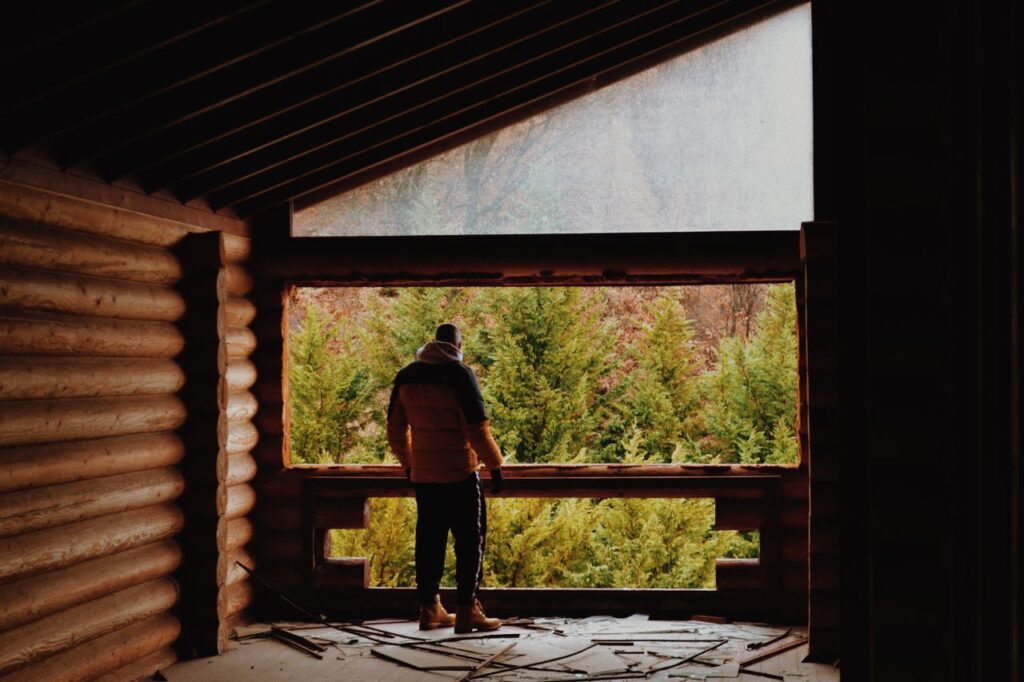
1. Pick a size and a build method first
Square footage drives almost every other line, so settle it before anything else. A 200 sq ft weekend cabin and a 600 sq ft full-time home are different projects, not bigger and smaller versions of the same one.
Build method sets your cost per square foot. According to Bob Vila’s cabin cost guide, typical ranges are:
- Log cabin kit (you assemble): $50 to $80 per sq ft
- Prefab cabin: $80 to $230 per sq ft
- A-frame or standard contractor build: $125 to $175 per sq ft
- Custom build: $300 to $500 per sq ft
A kit price usually covers the shell and little else. Foundation, utilities, and interior finishes are on you, which is exactly where the surprises live.
2. Site prep and access
Before a single log goes up, a concrete truck, a well rig and a septic crew all need to reach your site. If they can’t, nothing else happens.
The same Bob Vila guide puts land leveling or clearing at roughly $1,370 to $5,671 on rocky or hilly sites, and up to three times more on heavily wooded land. A driveway adds $2,500 to $6,600. A land survey, often required on undeveloped parcels, runs $380 to $540.
Walk the route a loaded truck would take. Soft ground, a steep grade or a tight turn can add days of gravel and grading you never planned for.
3. Foundation options
For most small homestead cabins, the choice comes down to piers, a slab or a crawlspace. Bob Vila lists these materials-only ranges per square foot:
| Foundation | Materials cost per sq ft | Best fit |
| Concrete piers (pier and beam) | $6 to $12 | Sloped or wooded sites, small footprints |
| Slab on grade | $4 to $14 | Flat, well-drained ground |
| Crawlspace | $5 to $16 | Cold climates, easy plumbing access |
Piers are popular with DIY builders because you can dig and pour them yourself. In cold climates, though, they leave pipes and floors exposed, so budget for skirting and insulation. Footings need to go below your local frost line, which your building office can tell you.
4. Water: well or rain catchment
Water is the line most likely to blow up a budget, because nobody knows how deep the water is until the rig hits it.
Drilled well. Bob Vila’s well drilling guide puts the national average at $5,500, with residential drilling at $15 to $30 per foot. A 150 ft well with 4-inch casing averages about $5,300, while a 300 ft well runs about $10,700. Then add a pump ($300 to $2,000), a pressure tank ($100 to $700) and $50 to $150 per foot to run water and power lines to the cabin. Ask neighbors how deep their wells went; it is the best predictor you have.
Rain catchment. HomeAdvisor puts a rooftop collection system at $1,000 to $5,000, about $3,000 on average. A 5,000-gallon polyethylene tank alone is $2,000 to $4,000. If you plan to drink it, add filtration; HomeAdvisor lists treatment systems at $1,130 to $3,540. Check your state’s rainwater rules before you rely on it as your only source.
5. Wastewater and septic
What goes in has to come out, and your county health department will have opinions about how.
Conventional septic. Bob Vila’s septic guide lists a typical install at $3,109 to $9,677, averaging $6,361. Before any of that, you need a percolation test, roughly $1,000 to $2,000. If the soil fails, an engineered or mound system can run $12,000 to $15,000 or more.
Composting toilet. A commercial composting toilet costs about $1,000 to $1,500 for light use, per a University of Washington overview. That doesn’t remove the need to handle sink and shower water, and many counties still require a septic or approved greywater system for a dwelling. Call the health department before you design around one.
6. Off-grid power
Size your solar system for your darkest month, not your sunniest. TheGreenWatt’s cabin sizing guide notes that winter output can fall 40 to 60 percent below summer at most U.S. latitudes.
That guide estimates a cabin that cooks and heats with propane uses about 4 to 6 kWh a day. Its sample DIY equipment budgets:
- Weekend cabin: $3,000 to $4,500 (four 400W panels, small lithium battery)
- Year-round, standard: $5,500 to $7,500 (adds a well pump and washer)
- Year-round, premium: $7,500 to $12,000 (larger battery bank and inverter)
Professional installation adds $2,000 to $5,000. Budget for a small backup generator too; a few hours of runtime on a cloudy week is far cheaper than doubling your panels.
7. Heat
Electric heat will drain a solar battery bank in hours, so most off-grid cabins burn wood or propane.
A wood stove is the homestead standard. Bob Vila’s wood stove guide puts installation at $325 to $4,000, with noncatalytic stoves at $400 to $2,900. In a new cabin without a chimney, budget for one: a 15-foot chimney runs $900 to $3,000, plus a hearth pad at $200 to $500.
Wood stoves also need no electricity, which matters when your power comes from the sun.
8. Permits still apply on rural land
Rural doesn’t mean unregulated. Off-grid doesn’t either. Expect some or all of these:
- Building permit: set by your county, often tied to square footage
- Septic permit and perc test: $400 to $2,500 for permits, plus $1,000 to $2,000 for the test
- Well permit: $5 to $500
- Wood stove permit: $50 to $250
Some counties also set a minimum dwelling size or limit how long you can live in a cabin seasonally. A 20-minute call to the zoning office before you buy materials can save you a teardown.
9. Sample budgets for three common sizes
Here is how the ranges above add up. The low end assumes a kit you assemble yourself and easy site conditions; the high end assumes a hired-out shell and harder ground. These are planning estimates built from the sources in this article, not quotes.
| Line item | Weekend cabin (200 sq ft) | Part-time cabin (400 sq ft) | Full-time cabin (600 sq ft) |
| Shell ($50 to $175 per sq ft) | $10,000 to $35,000 | $20,000 to $70,000 | $30,000 to $105,000 |
| Site prep and driveway | $3,000 to $12,000 | $3,000 to $12,000 | $4,000 to $15,000 |
| Foundation (piers) | $2,000 to $5,000 | $3,000 to $8,000 | $4,000 to $12,000 |
| Water | $1,000 to $5,000 (rain catchment) | $3,000 to $9,000 (catchment plus filtration) | $5,000 to $18,000 (drilled well) |
| Wastewater | $1,000 to $2,600 (composting toilet) | $1,500 to $10,000 | $3,000 to $15,000 (septic) |
| Solar power | $3,000 to $4,500 | $5,500 to $7,500 | $7,500 to $17,000 (pro install) |
| Heat | $1,500 to $4,000 | $2,000 to $6,000 | $2,000 to $6,000 |
| Permits and tests | $500 to $3,000 | $1,000 to $4,000 | $2,000 to $5,000 |
| Total | $22,000 to $71,000 | $39,000 to $127,000 | $58,000 to $193,000 |
These totals leave out land, interior finishes and furnishings, which you should budget separately. Add a 10 to 15 percent contingency on top; on a build like this, something always comes up.
10. Where DIY saves the most, and where to hire out
The biggest single saving is assembling the shell yourself. The gap between a $50-per-foot kit and a $175-per-foot hired build is $75,000 on a 600 sq ft cabin. Even on the 12×20 (240 sq ft) log cabin I built myself in 2023, that same gap works out to roughly $30,000.
Good DIY jobs:
- Shell assembly from a kit, with a couple of capable helpers
- Clearing brush and prepping the septic and drain field area
- Digging and pouring piers, if your soil is stable
- Mounting a ground solar array and running conduit
- Interior finishing: insulation, flooring, trim, paint
Hire these out:
- Well drilling. It takes a rig and a license.
- Septic installation. Many states require a licensed installer.
- Final electrical connections and inspection. A battery bank stores serious energy.
- Wood stove and chimney. Clearances matter, and a mistake can burn the cabin down.
- Foundation engineering on poor soil. A few hundred dollars for an engineer beats a sinking cabin.
The bottom line
On a small off-grid cabin, the cabin itself is only about half the bill. Water, waste, power, heat, and access make up the rest, and they’re the lines most people underestimate.
Price those first, get local quotes for the well and septic before you buy a kit, and keep a real contingency. Do that, and the only surprise left is how much you’ll enjoy the place once it’s done.

Jason Keeley
Jason Keeley has spent 25 years on hands-on DIY building and renovation projects. He runs Cabin Calculator, a free cost estimator for people planning a cabin or log home.