A mobile chicken coop sounds simple enough. Give the chickens a secure place to sleep, add wheels underneath, and move it around the property when the ground needs a break.
In practice, it is a little more than that.
A chicken tractor lives outdoors, gets moved regularly, takes plenty of wear and tear, and has to work for both the chickens and the person looking after them. A design that looks good in a product photo can feel very different after a few months of moving it across grass, dealing with rain, collecting eggs, and trying to get everything done before breakfast.
So rather than looking at a long list of features, it makes more sense to think about how you will actually use the coop.

Start with your land
Before worrying about materials or wheel systems, think about where the chicken tractor will live.
Is your property mostly flat grass, or are there slopes and uneven areas? Will you be moving the tractor every day, every few days, or only when an area has been grazed down? Do you have plenty of room to rotate the flock, or will the tractor stay within a relatively small area?
These details can change what matters most.
A large tractor might make sense for a bigger flock, but it also needs more room to maneuver. A smaller setup may be easier to move frequently, particularly on a smaller property.
The key is to choose a size and layout that fits how you actually intend to use it, rather than choosing the biggest enclosure you can fit on paper.
Weight matters when you have to move it
One of the biggest differences between a mobile coop and a stationary chicken shed is that you actually have to move it.
That sounds obvious, but it is easy to underestimate how much difference the frame and wheel system can make.
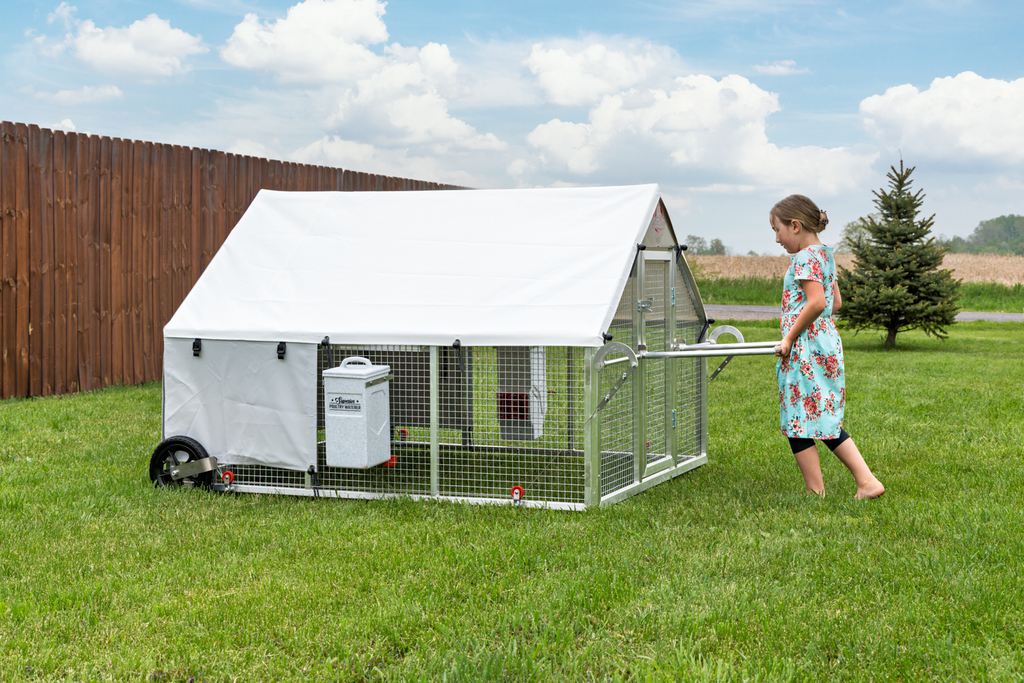
A mobile structure needs to be sturdy enough for outdoor use without becoming unnecessarily difficult to move. This is one reason aluminum can make sense for a chicken tractor. It provides strong structural support without the weight of many heavier steel constructions, and aluminum is naturally resistant to corrosion.
The way the wheels work matters too.
Large solid wheels and a system that gives you some mechanical advantage can make moving a substantial coop much easier than simply attaching small castor-style wheels and hoping for the best.
For example, Cluckington’s Alumi Coop range is a well-established option for Australian chicken keepers, using T5 and T6 aluminum, TIG-welded construction, galvanized welded mesh and an Alpha-Lite wheel system designed to help raise and move the coop. The combination shows why it’s worth looking at the complete construction rather than judging a mobile coop by its frame material alone.
Outdoor construction matters more than it first appears
A chicken tractor doesn’t get to spend its life under cover. It sits in the sun, gets rained on, collects dust and mud, and gets dragged across the ground. Over time, those conditions will tell you a lot about the quality of the construction.
The frame is one part of that equation. Corrosion resistance is particularly useful for equipment that is permanently exposed to the weather. Weld quality and how different components join also matter because the structure will move every time it is relocated.
Then there is everything attached to the frame. Mesh, fasteners, hinges, wheels and covers all have to cope with outdoor conditions as well. A strong frame doesn’t help much if another part of the tractor becomes the weak point.
This is where it is worth looking beyond the headline material and checking what the structure is actually made from.
The cover has a job to do
A mobile coop needs to provide shelter without becoming a sealed box. The covered section should give the birds somewhere to get out of rain and harsh weather, while the open mesh areas keep the enclosure suitable for outdoor use.
For wet climates in particular, the quality of the cover is worth paying attention to. A heavy-duty, marine-grade vinyl cover designed to shed water is very different from a lightweight tarp simply stretched over a frame.
It’s also worth thinking about how the cover is attached. A cover that fits properly and is designed for outdoor exposure is less likely to become another maintenance job every time the weather turns.
Wind deserves some thought too. A large covered structure can catch wind, so placement and setup matter just as much as the material itself. If your property gets strong winds, set up the tractor according to the manufacturer’s guidance rather than assuming a heavy coop cannot move.
Think about predators in terms of your property
Predator protection is another area with no universal answer. A homestead in an area with foxes has different concerns from one dealing mainly with snakes, birds of prey or other animals.
The useful question isn’t simply, “Is this chicken tractor predator-proof?” Instead, look at how the enclosure is constructed.
The mesh size and strength matter. Ground contact matters. Door and latch design matters. And in some locations, additional protection may be worthwhile.
For example, a galvanized welded mesh enclosure gives you a much more substantial barrier than lightweight chicken wire. A tractor that sits properly against the ground also leaves fewer obvious gaps underneath it.
If snakes are a particular problem on your property, you can add finer snake mesh to some designs. Likewise, electric hotwire systems are an option where additional deterrence is appropriate.
The right combination depends on the predators you are actually dealing with. There is little point paying for features designed around a problem you don’t have, while overlooking the one that is common in your area.
Choose the size around the flock
The number of chickens you keep will obviously influence the size of the tractor, but don’t look at flock numbers in isolation. Think about the birds, the amount of ground available and how frequently you intend to move them. A tractor designed for a small backyard flock will have very different dimensions from one intended for several dozen laying hens.
As a rough example, mobile tractor ranges commonly step up from smaller enclosures for around ten laying hens to substantially larger structures for 30 or more birds. Check the manufacturer’s stated capacity for the particular model rather than assuming all tractors with a similar footprint are intended for the same number of chickens.
Also remember that flock composition can change the numbers. Laying hens, broilers, ducks and turkeys don’t necessarily have the same space requirements or use the enclosure in the same way.
If you are starting with six hens but expect to have fifteen in a year or two, it may be worth thinking about that before buying your first tractor.
Don’t forget the jobs you do every day
A chicken tractor can be beautifully constructed and still become frustrating with the everyday jobs. Think about how you will:
- Fill the feeders
- Refill water
- Collect eggs
- Check the birds
- Clean or inspect the enclosure
- Move the tractor
- Get inside when necessary
Small details become important when you repeat them every day.
External feeders and waterers can make routine jobs easier because you don’t always need to enter the enclosure. Roll-out nesting boxes can simplify egg collection and cleaning. A properly sized access door matters when you need to get into the coop, not just reach through the mesh.
These aren’t glamorous features, but they are the things you notice after living with the tractor for a while.
Think about weather beyond rain
Rain is usually the first thing people think about when they hear “weather protection”, but it isn’t the only consideration. Direct sun, wind and changing temperatures can all affect how comfortable the birds are and how much wear the structure takes.
A covered section provides shade and shelter from rain. On some larger designs, roll-down side panels can also provide extra protection when conditions get colder or windier.
At the same time, you don’t want the enclosure to become completely closed off. The design needs to provide shelter while still allowing the birds to use the open areas of the tractor.
Your local climate should therefore influence the balance between covered and open sections, as well as where you position the tractor on the property.
Your property will tell you how often to move it
One advantage of a chicken tractor is being able to move the flock onto fresh ground. But no magic schedule works for every property. Pasture growth, rainfall, flock size, stocking pressure, and ground condition all affect how quickly an area needs to be moved on from.
If the tractor is leaving the ground bare, becoming muddy, or accumulating too much manure in one area, that is useful information. If the pasture is recovering well and the birds are using the area well, your rotation may be working.
This is another reason mobility matters. A tractor that is genuinely practical to move gives you more flexibility to respond to what is happening on the ground.
A Few Key Points from This Guide
Rather than starting with a checklist of fashionable features, think about the realities of keeping chickens outdoors. A practical mobile coop should suit:
- Your flock.
Choose a size that works for the number and type of birds you intend to keep. - Your property.
Consider slopes, grass, access, available space, and how far the tractor needs to move. - Your climate.
Look for construction and covering designed for outdoor exposure, especially if the tractor will stay outside year-round. - Your local predators.
Pay attention to mesh, ground contact, doors and any additional protection that makes sense for your area. - Your routine.
The easier it is to move, feed, water and access the birds, the more likely you are to enjoy using the system long-term. - The construction.
Look beyond a product’s appearance and check the frame material, welds, mesh, cover, wheels and other components that will take the brunt of outdoor use.
The best mobile chicken coop isn’t necessarily the biggest one, the lightest one or the one with the longest list of features. It is the one that makes sense for your chickens and your property. If you know how many birds you want to keep, where you’ll use the tractor, what sort of weather and predators you are dealing with, and how often you realistically want to move it, choosing a suitable design becomes much easier.
That’s probably the most useful way to look at a chicken tractor in the first place. It’s not just a chicken house with wheels. It’s a piece of working equipment on your homestead, and it needs to work for you as well as the chickens.