The average U.S. electricity customer went 11 hours without power in 2024, nearly twice the yearly average of the decade before, according to the U.S. Energy Information Administration.
Major events such as Hurricanes Beryl, Helene and Milton accounted for 80% of those hours. Totals vary by state, but the agency’s state reliability data shows Connecticut customers, for example, averaging about two and a half hours that year.
On a homestead, an electric well pump stops delivering water the moment the power drops, and a chest freezer full of last fall’s meat starts to thaw. When considering a generator, there are some distinct differences between two main types, which is why we have compared them side by side, along with the farm loads that usually decide between them.
How the Two Types Differ
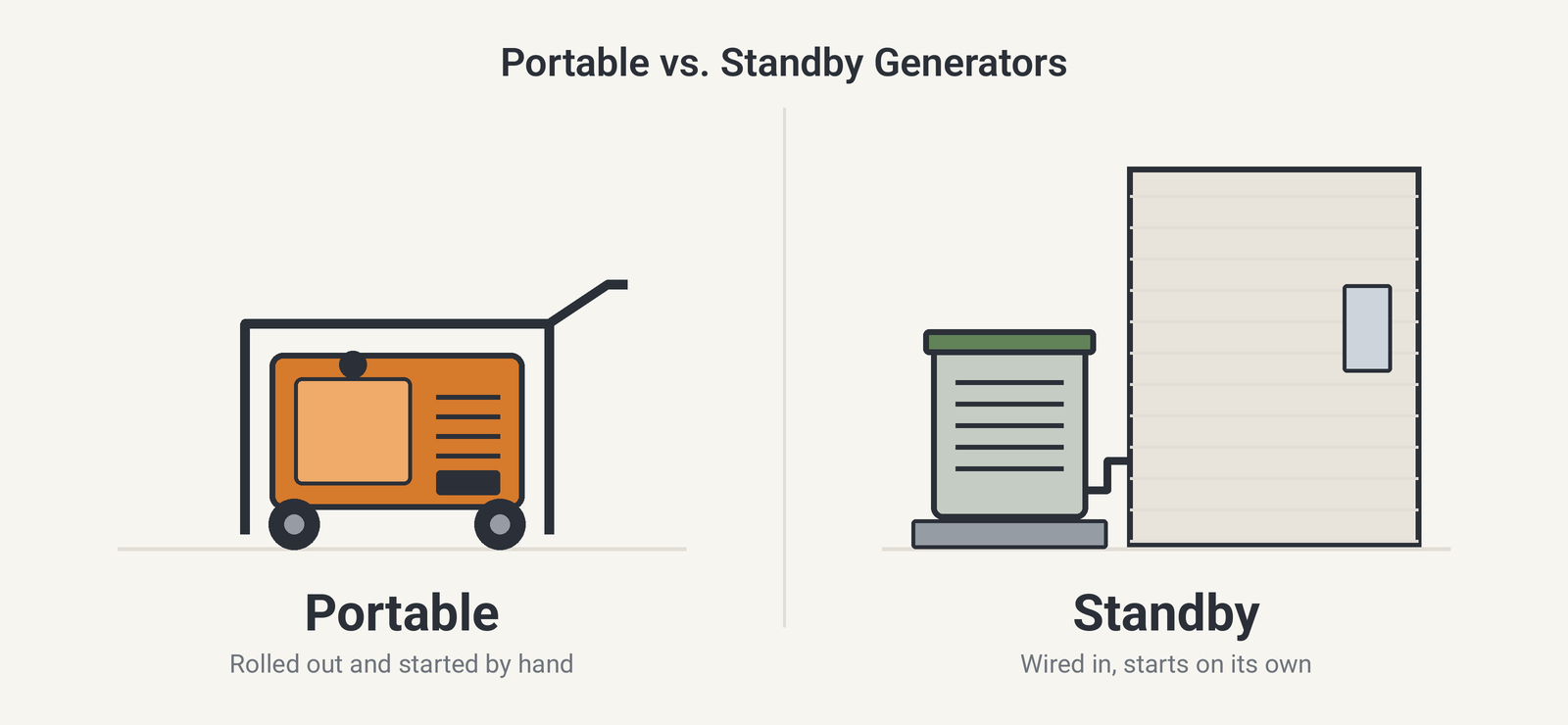
Most portable generators sold for home backup burn gasoline from a tank on the frame, and you start them by hand once you roll the unit out into the yard.
A standby generator sits on a pad beside the house, wired into the panel and plumbed to the natural gas line or the propane tank. Its automatic transfer switch monitors the utility feed, starts the engine when it drops, and switches the house circuits over without anyone going outside.
| Feature | Portable generator | Standby generator |
| Starting | Pull cord or electric start, by hand | Starts on its own through an automatic transfer switch |
| Fuel | Usually gasoline; some models also burn propane | Natural gas line or a propane tank |
| Location | Kept in a shed or garage, run at least 20 feet away from the house | Permanently mounted outside on a pad |
| Connection | Extension cords, or an electrician-installed transfer switch | Hardwired to the electrical panel |
| Runtime | Until the tank needs refilling | As long as the gas supply holds |
| Install | None for cord use | Permits, pad, and electrical work |
What a Portable Generator Asks of You
A portable unit costs less to buy than a permanent system, and you can wheel it to the barn or a fence-line job when the house doesn’t need it. Someone still has to haul it out and keep it fueled through the storm, often at night.
The Consumer Product Safety Commission says to run a portable generator at least 20 feet from the house, never on a porch or in a carport, with the exhaust pointed away from doors and windows. Opening a window does not clear the gas. The agency counts nearly 100 deaths a year in the U.S. from carbon monoxide produced by portable generators, and it suggests looking for models with a CO shut-off feature.
Keeping a portable unit fueled through a long outage brings its own rules, and the American Red Cross lists them in its generator guidance:
- Let the engine cool before refueling. Gasoline spilled on hot engine parts can ignite.
- Store fuel in an approved safety can, outside living areas and away from fuel-burning appliances like a gas water heater in the garage.
- Local laws may cap how much fuel you can keep on the property; the fire department can tell you the limit.
- Extension cords should be outdoor-rated for at least the combined load, with no cuts and an intact grounding pin.
One shortcut the Red Cross warns against is backfeeding, or plugging a generator into a wall outlet to power the house wiring. It puts utility line workers, neighbors, and your own household at risk of electrocution. Running household circuits from a portable unit calls for a transfer switch installed by an electrician to the National Electrical Code.
Where a Standby Generator Earns Its Place
If chores have you out on the back forty or a trip leaves the animals with a sitter, a standby unit brings the well and the freezers back on without anyone touching a switch. It also burns fuel you already keep up for the house, with no gas cans to fill in the middle of a storm.
A permanent unit does need a pad, a fuel connection, a transfer switch and usually a permit. Pad work, permits, and options such as a load manager that splits the house into priority zones all add to the cost of a standby installation.
Distance adds up on rural property as well, with the placement of the propane tank, the panel, and the best spot for the unit being far apart. According to the Connecticut residential electricians at Santella Electric:
“In general, the installation price will go up the further away a unit is placed from its fuel source and circuit panel.”
Sizing Around Homestead Loads
To size either type, the Red Cross suggests adding up the wattage on the labels of everything you want powered, converting watts to amps by dividing by the voltage, and choosing a generator that produces more amps than the total. Some machines draw up to three times their running power when they start, and on a farm those are usually the motors in pumps and freezer compressors.
On a homestead, the list tends to look like this:
- A submersible well pump, often hardwired into the panel instead of plugged in, which a portable unit cannot reach without a transfer switch. Homes on a well lose running water when the pump stops, one of the lessons a long power outage teaches.
- Chest and upright freezers, which hold their temperature longest when they are full and the lids stay shut.
- Stock tank heaters and heated waterers, needed most in the same winter storms that bring down lines.
- A sump pump, furnace blower or any power-dependent medical equipment in the house.
Large appliances often run on 240 volts instead of the 120 volts most household devices use, and the Red Cross suggests asking an electrician when the power needs get complicated.
Which One Fits Your Place
Most of this decision rests on how long your outages run and how much of the farm has to keep working through them. A portable generator tends to fit when outages are short and occasional, someone is always home to run it, and the critical loads come down to a freezer, a few lights and phone chargers.
A standby unit is the stronger choice in a few situations:
- The well pump is hardwired and the household can’t go a day without water.
- You travel or work off the property, and nobody would be there to start a portable unit.
- Animals depend on heated water through winter storms.
- Your area has a record of outages that last several days.
Owning both is another route, with a standby unit on the house and a portable one for the barn or for work away from the panel. A generator also doesn’t replace the basics on this list of things to keep in your home for unexpected power outages. Start with a written list of every load you need and the wattage printed on each label.